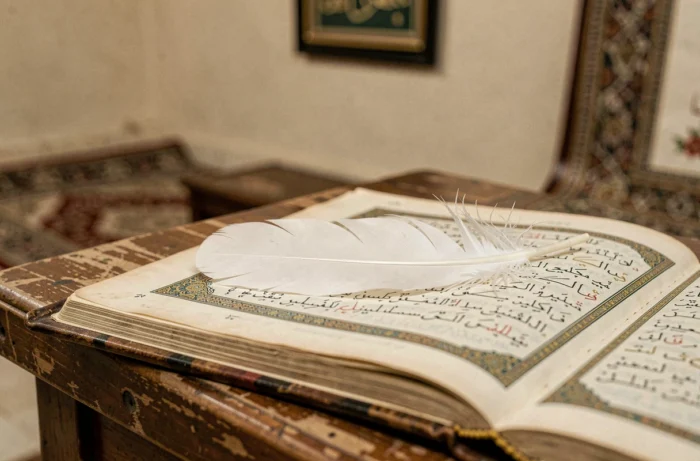
In Islam, finding a white feather in the house is not addressed by any specific teaching in the Quran or hadith collections. Common associations (guardian angel, message from a deceased loved one, divine protection) come from other spiritual traditions and have become mixed online with interpretations wrongly presented as Islamic. Understanding what religious sources actually say about this kind of sign means revisiting a few specific concepts in Muslim tradition.
Ṭiyarah and omens: what Islamic tradition forbids
The central concept for addressing this question is ṭiyarah, an Arabic term for drawing a good or bad omen from an object, animal, or observed event. Before Islam, Arabs practiced ṭiyarah by watching the flight of birds to decide whether to set out on or cancel a journey.
A hadith reported in several collections clearly establishes the Prophet’s position: “There is no ṭiyarah.” This wording leaves no room for interpretation. Attributing to a feather found on the ground the power to announce good news, confirm a choice, or signal the presence of an angel is precisely what ṭiyarah entails.
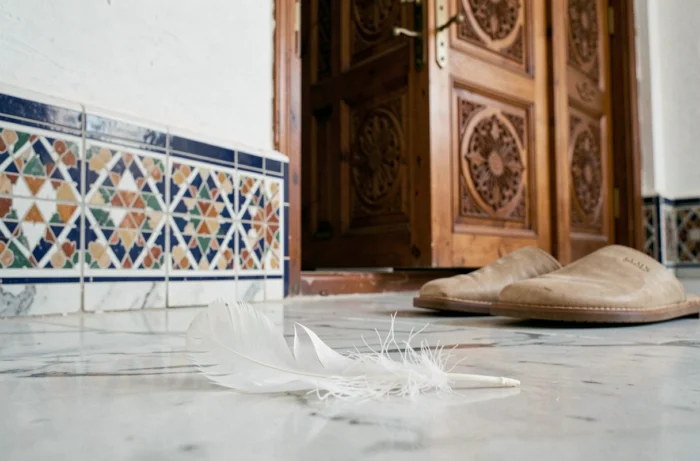
In practical terms, this means that a white feather in Islam is not considered a message addressed to the person who finds it. The feather remains a natural object, probably carried in by a draft or left behind by a passing bird.
Fa’l and optimism: the nuance often confused
That does not mean Islamic tradition is opposed to every positive response to an everyday event. It distinguishes ṭiyarah from another concept: fa’l. Fa’l refers to spontaneous optimism, usually prompted by hearing a kind word or encountering an encouraging situation.
The difference is fundamental. Fa’l does not imply that an object or event has predictive power. Feeling a sense of calm when seeing a white feather is not inherently condemned. The problem arises when one takes the next step: believing that the feather confirms a choice, announces protection, or conveys a divine message.
Three criteria for distinguishing fa’l from ṭiyarah
- Fa’l remains a passing inner state; it does not change a concrete decision (moving house, marriage, investment).
- Ṭiyarah begins when causal power is attributed to an object: “This feather means my project will succeed.”
- Fa’l is not based on a codified system of interpretation (the feather’s color, size, or location), unlike the esoteric frameworks found online.
The comfort one feels is not the same as interpreting an omen. This distinction helps avoid excessive guilt while respecting the theological framework.
Istikhāra and the white feather: why the conflation is problematic
Some online content suggests that finding a white feather after praying istikhāra constitutes a divine answer. Istikhāra is a prayer for guidance in which the believer asks Allah to make what is good easier for them and to keep what is harmful away.
Islamic sources that discuss istikhāra do not mention any physical sign as an expected answer. The answer may come through events becoming easier or obstacles arising, through a sense of inner peace, or through advice received in consultation with others (shūrā). A feather on the living room floor meets none of these criteria.
Waiting for a physical sign after istikhāra reintroduces the logic of omens into a practice designed to move beyond it. This is one of the most common conflations in articles that mix general spirituality with Islamic teachings.
White feathers and non-Islamic beliefs: where the confusion comes from
Most interpretations in circulation (guardian angel, message from a deceased loved one, protection of the home) originate in distinct traditions:
- Modern spiritualism, which has associated white feathers with communication with the dead since the late 19th century.
- Native American traditions, in which the white feather has its own symbolism associated with peace and courage.
- Contemporary New Age spirituality, which has compiled these varied sources into universal interpretive frameworks, often presented as applicable to all religions.
The problem arises when these frameworks are labeled “meaning in Islam” without any Quranic or prophetic reference. The absence of an Islamic textual source is the first indication that an interpretation belongs to another belief system.
What the Quran says about birds
The Quran mentions birds several times, notably in Surah An-Nahl (verse 79), where they are presented as a sign of Allah’s creative power. Their flight is described as a manifestation of the natural order, not as a channel for individual communication. As an extension of the bird, the feather likewise belongs to this order: it is part of creation, not a messenger.

The next time a white feather appears in a hallway or on a windowsill, Islamic tradition invites a simple response: appreciate creation without attributing a message to it. The comfort one feels belongs to the person feeling it; the feather belongs to the bird.