
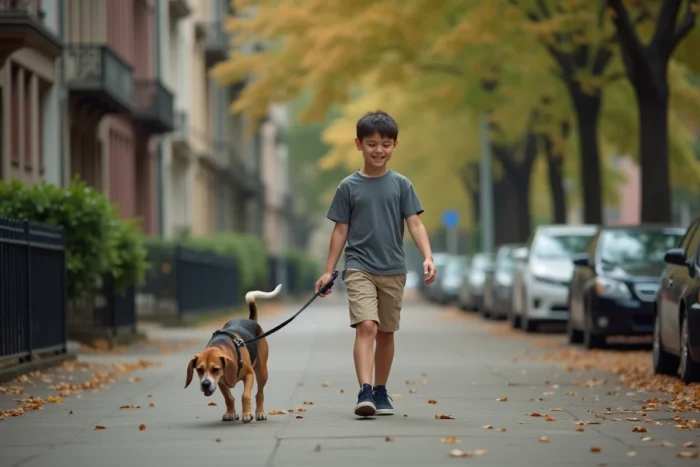
A 14-year-old who walks the neighbor’s labrador every Wednesday for a ten-euro bill seems like a small service between individuals. But as soon as money starts to flow regularly, French legal frameworks transform this helping hand into a regulated activity. Understanding from what age one can start dog sitting as a minor involves untangling three threads: labor law, animal regulations, and civil liability.
Civil liability and insurance: the real barrier for a minor dog sitter
Most online content focuses on the legal working age. The real issue arises earlier: coverage in case of an incident. A dog in care that bites a passerby, swallows an object, or escapes holds the caretaker liable.
For a minor, civil liability falls on the parents or legal guardians. Family civil liability insurance generally covers damages caused by household members, including a teenager. Checking the “pet sitting” clause in the home multi-risk insurance contract is the first step, well before looking for a client.
If the activity becomes regular or paid, standard family coverage may no longer be sufficient. Professional liability insurance is then required, and its subscription by a minor requires parental consent. When considering dog sitting as a minor, this insurance question conditions everything else.
Minimum age for dog sitting: what labor law says
In France, the work of minors is allowed from the age of 16 with the consent of legal representatives, and exceptionally from 14 for light work during school holidays. Keeping a dog for a week in the summer falls into this category of light work, provided that the duration and conditions remain regulated.
Under 14: only family volunteering
A child aged 12 or 13 can take care of a relative’s dog without payment. This is considered a service provided, not an economic activity. No declaration is necessary, but adult supervision is still recommended, especially with large breeds.
Between 14 and 16: a very limited framework
Occasional and sporadic pet sitting remains possible, typically during school holidays, with written permission from parents. The teenager cannot create a self-employed status (reserved for adults or emancipated minors). Payment is therefore made informally between individuals, without invoicing.
From 16 years old: more possibilities
A 16-year-old can work more regularly with parental consent. However, pet sitting platforms like Rover require users to be 18 to create a profile. Access to professional platforms is therefore blocked before adulthood, which limits visibility and the volume of potential clients.
ACACED and DDPP declaration: obligations that change everything at 18
Keeping animals for payment in France falls under a regulated professional activity. Two obligations apply as soon as one operates commercially:
- Obtaining the ACACED (Certificate of Knowledge for Domestic Pet Species), a training course validated by an exam, renewable every ten years.
- Declaring with the DDPP (Departmental Directorate for the Protection of Populations), which allows obtaining a SIRET number linked to the activity.
- Subscribing to professional civil liability insurance covering the animals in care and any potential damages to third parties.
These steps require a declared legal status (micro-enterprise, for example). However, an unemancipated minor cannot create a business without specific judicial decision. In practice, the professional exercise of dog sitting thus truly begins at 18.
The distinction between occasional care between individuals and declared commercial activity is a point that forums and blog articles rarely address. Walking a neighbor’s dog once a week does not trigger the same obligations as offering services on a platform or through regular advertisements.

Preparing the ground before 18: concrete skills and experience
Waiting until adulthood to start professionally does not mean remaining inactive. Teenagers who want to work with animals later should accumulate practical experience from the age of 14-15.
Volunteering to care for the dogs of acquaintances helps develop reflexes: reading canine body language, managing leash walks, respecting feeding schedules, reacting to a fearful or reactive dog. These situations cannot be learned in an online course.
Some shelters and animal protection associations accept minor volunteers (usually from 16 years old, with parental permission). Regular contact with dogs of various profiles, including fearful or poorly socialized animals, provides a field training that ACACED cannot replace.
- Offering services for free to family and neighbors to build a recommendation portfolio.
- Getting involved with a local shelter for supervised volunteering from the age of 16.
- Observing the work of a professional pet sitter during an internship or immersion, if the school allows it.
These early experiences make a difference when creating a profile on a platform or taking the ACACED. Dog owners are more likely to trust their pet to someone who can describe concrete care situations rather than to a candidate with only a theoretical certificate.
The answer ultimately comes down to two levels. Before 18, one can care for dogs occasionally and non-commercially, with parental consent and verification of family insurance coverage. To turn it into a paid, declared activity covered by French health obligations, one must wait until adulthood, obtain the ACACED, and declare the activity with the DDPP.