The telephone prefix +30 corresponds to Greece. Behind this international code lies a country whose telecommunications network has evolved well beyond simple voice calling. Understanding how this prefix is used, what it covers in terms of local numbering, and what distinguishes it from neighboring codes can help avoid several common mistakes when calling to or from Greek territory.
Prefix +30 compared to neighboring country codes
The +30 is often confused with other nearby codes in the European area. The table below compares Greece with its direct geographical neighbors to clarify the differences.
| Country | International Code | Exit Code | Emergency Number |
|---|---|---|---|
| Greece | +30 | 00 | 112 |
| Turkey | +90 | 00 | 112 |
| Albania | +355 | 00 | 112 |
| Bulgaria | +359 | 00 | 112 |
| Italy | +39 | 00 | 112 |
Greece is one of the few European countries with a two-digit international code. Most neighboring countries use three-digit codes. This brevity of +30 reflects the historical allocation by the International Telecommunication Union, which reserved short codes for networks that were already well established at the time of standardization.
A detailed article discusses the telephone prefix +30 and its country, explaining the dialing rules from France and other European countries.
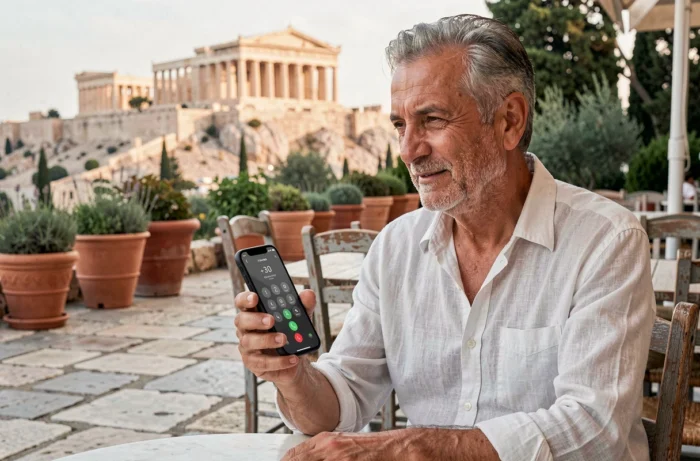
Greek dialing format: dialing a number without error
Greece uses a closed numbering system. This means that all Greek numbers are dialed with the area code, even for a local call. A landline number in Athens starts with 21, a mobile number with 69.
From abroad, the dialing rule is simple: you dial the international exit code (00 or the + sign), then 30, followed by the full number of the correspondent. The initial zero, common in other countries, does not exist in Greece. Dialing 0030 069… instead of 0030 69… is a common mistake that prevents the call from going through.
Greek landline and mobile numbers
- Landline numbers start with 2, followed by the city code (1 for Athens, 310 for Thessaloniki, 610 for Patras, among others), then the subscriber’s number, for a total of ten digits.
- Mobile numbers always start with 69, followed by eight digits. Greek mobile operators assign distinct ranges (690, 693, 694, 697, 698).
- Special service numbers (information, assistance) use short formats of three, four, or five digits, which cannot be reached from abroad with +30.
This distinction between landline and mobile is visible from the first two digits after +30. A number starting with +30 2 is a landline, while a number starting with +30 69 is a mobile.
112 in Greece: an emergency network integrated with prefix +30
Competing pages on the subject limit themselves to explaining how to dial +30. None mention the civil safety aspect of Greek numbering, which has gained considerable importance in recent years.
The 112 works in Greece without a SIM card, from a locked phone, and with assistance available in English. This European emergency number provides access to all Greek emergency services.
Greek emergency numbers beyond 112
The official Greek portal lists several dedicated lines, each linked to a specific service:
- 166 for ambulance (EKAB, the national emergency medical service)
- 100 for police
- 199 for fire and emergencies
- 108 for coast guard, a logical number for a country with thousands of islands
These short numbers only work from Greek territory. From abroad, only +30 followed by the full number of an administrative service allows you to reach the authorities.
Cell Broadcast Alerts and prefix +30
Greece uses the 112 Cell Broadcast system to send evacuation alerts directly to phones present in a risk area. During wildfires, this system sends geolocated messages to devices connected to the Greek mobile network, including those roaming with a foreign plan.
This system requires neither an app nor registration. It relies on the infrastructure of the Greek mobile network, meaning that any phone picking up a signal under prefix +30 receives the alert. For a traveler, this changes the perception of +30: this code is not just a telephone identifier; it becomes a vector of civil safety.
Calling Greece from a French mobile plan: cost and network
A call to a +30 number from France is charged as an international call, unless the plan includes calls to Europe. From the EU area, roaming calls to Greece are covered by the “roam like at home” regulation, which eliminates extra costs for European subscribers traveling there.
However, calling a +30 number from France (without being in Greece) remains a classic international call. The distinction is subtle but costly: being in Greece and calling a local Greek number costs no more than a national call, while calling Greece from a Parisian couch depends on the subscribed plan.
Greek mobile networks operate on GSM 900 and GSM 1800 for 2G, with extensive 3G and 4G coverage across the mainland and major islands. A recent European phone is compatible without special adjustments.
The prefix +30 identifies Greece in the international numbering plan, but it also encompasses an ecosystem of emergency numbers, a Cell Broadcast alert system, and specific dialing rules that mere knowledge of the country is not enough to master. Checking the number format (landline in 2, mobile in 69) and knowing that 112 works even without a SIM card remains the practical foundation to remember before any call or trip.