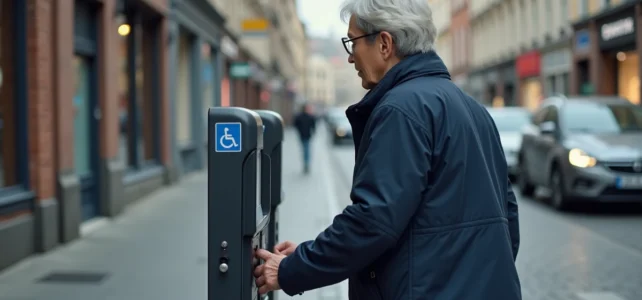
The disabled button present on most French parking meters still generates a lot of confusion. Between cities that require a free ticket via this button and those where the CMI-S card is sufficient behind the windshield, the differences in operation from one municipality to another complicate users’ lives. Understanding these differences helps avoid an unjustified parking fine.
Comparison of procedures by city: parking ticket or card only
Not all French municipalities apply the same procedure to validate the right to free parking for holders of the CMI-S. The table below summarizes the two main models encountered in the field.
| Criterion | “Disabled ticket” model (e.g., Paris) | “Card only” model (majority of municipalities) |
|---|---|---|
| Action at the parking meter | Press the disabled button, validate to obtain a free ticket | No action at the parking meter required |
| Visible document | Parking ticket + CMI-S behind the windshield | CMI-S only behind the windshield |
| Parking duration | Variable depending on the municipality (sometimes limited to a half-day renewable) | No duration limitation in the majority of cases |
| Risk of parking fine in case of forgetfulness | High: the absence of a ticket can trigger a fine | Low if the card is clearly visible and readable |
| Control by agents | Verification of the ticket + visual reading or QR code of the CMI-S | Visual reading or QR code of the CMI-S only |
Paris illustrates the most restrictive model. The city has implemented the “Ticket HANDI” system, which requires the holder of the CMI-S to generate a free ticket at the parking meter to indicate their presence in the space. Without this ticket, even with the card placed on the dashboard, an agent can issue a parking fine.
To understand the use of the disabled button on a parking meter, you must first identify the model applied in the municipality where you are parking. A quick call to the municipal road service clears up any ambiguity.

Disabled button on the parking meter: concrete step-by-step operation
On parking meters equipped with a dedicated button, the procedure remains simple, but each step counts to avoid a rejection or an invalid ticket.
- Locate the button identified by the wheelchair pictogram, usually located at the bottom right of the keypad or on a side panel of the machine
- Press this button once: the screen then displays a message confirming “disabled parking” or “CMI free”
- Validate without inserting a payment method (neither coins nor credit card): the parking meter issues a ticket for zero amount
- Place this ticket on the dashboard, next to the CMI-S, facing outward from the vehicle
On some recent models, the disabled button may require entering the license plate number before generating the ticket. This additional step directly feeds the database consulted by agents equipped with LAPI terminals (automated license plate reading). An incorrect license plate number triggers a fine as if no ticket had been issued.
When the parking meter does not have a disabled button
Some older machines or certain rural municipalities have not integrated this feature. In this case, the CMI-S placed behind the windshield is legally sufficient. The law guarantees free parking in all publicly accessible spaces for holders of this card, regardless of the parking meter’s equipment.
The problem arises when a monitoring agent only checks the digital database. If no ticket has been issued and the municipality uses a dematerialized system, the vehicle may appear as unpaid. Contesting the fine is possible, but the procedure takes time.
Parking fines and CMI-S: disputes on the rise
The litigation related to paid parking is significantly increasing. According to a Senate report, requests related to parking fines have risen from about 172,000 in 2023 to nearly 227,000 in 2025. A portion of these disputes concerns errors in configuration or understanding of CMI rights by automated systems.
Several situations generate contestable fines for CMI-S holders:
- Forgetting the parking ticket in municipalities that require it, while the card is clearly visible
- Illegible QR code of the CMI-S (damaged card, glare from the windshield, positioning too far back)
- LAPI control without a match in the database because the holder did not enter their plate at the parking meter
To contest, the holder must first file a mandatory prior administrative appeal (RAPO) with the entity that issued the fine, within one month. In case of rejection, an appeal before the Commission for the litigation of paid parking remains possible.
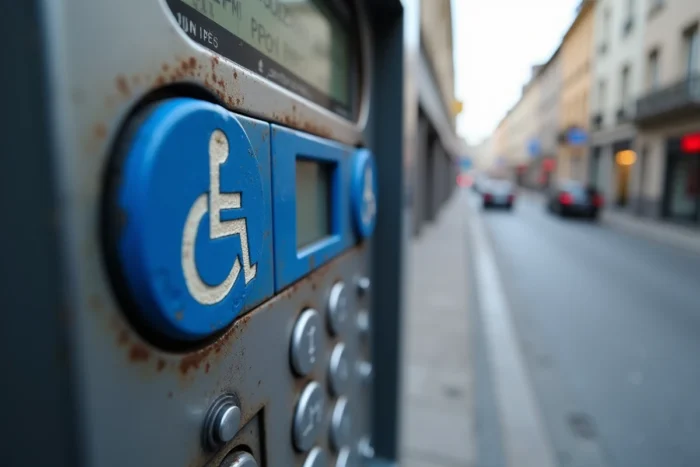
European parking card and parking meters abroad
Holders of the CMI-S traveling to Belgium, Spain, or other EU countries encounter a little-documented obstacle. Foreign parking meters generally do not have a disabled button. The right to free or reduced-rate parking then relies solely on the harmonized European card, visibly displayed in the vehicle.
The recognition of this card varies from country to country. In some Spanish cities, the card provides access to blue zones without time limits. In Belgium, free parking applies in reserved spaces, but regular paid spaces remain subject to the normal rate even with the card. Checking local regulations before each cross-border trip avoids surprises upon return.
The disabled button on the parking meter is just one link in a broader system. Its presence or absence does not change the right to free parking guaranteed by the CMI-S. What changes is the proof you leave behind your windshield, and the ability of the local system to read it correctly.