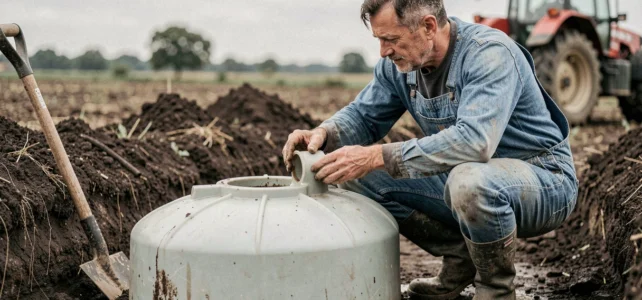
On a cereal or vegetable farm, the first warning sign is not the water bill: it’s the flow rate of the well dropping during peak irrigation. Storing rainwater in an underground tank allows for a reserve that can be mobilized without depending on the network or summer restrictions. However, the installation must be sized for agricultural use, where the volumes and soil constraints are nothing like those of a suburban home.
Soil Study and Terrain Constraints Before Excavation
You don’t dig a hole of several cubic meters without knowing the nature of the subsoil. In agriculture, plots often have heterogeneous profiles: swelling clay, shallow groundwater, old fill. A geotechnical survey, even a simplified one, prevents discovering a pocket of water at mid-depth on the day of excavation.
On clayey soil, lateral pressure varies significantly between dry and wet seasons. A tank placed without a stabilized sand bed risks floating when the water table rises, especially if it is empty. This is known as Archimedes’ thrust, and it is the classic trap of agricultural installations made without concrete anchoring.
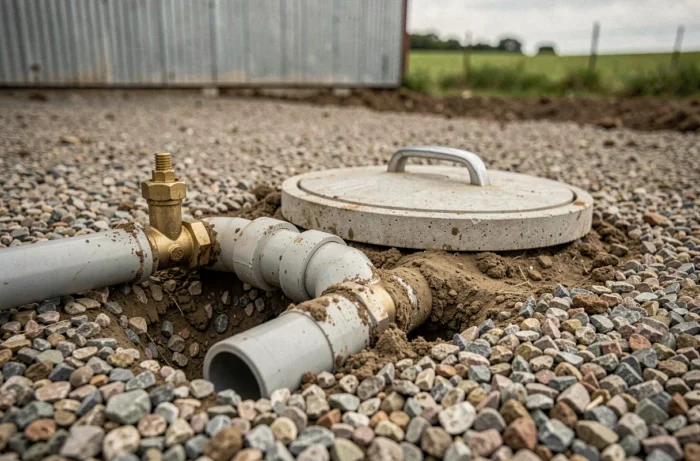
Before starting work, it is also necessary to check the distance from livestock buildings, slurry pits, and water catchment wells. Decree No. 2024-796, which came into effect on September 1, 2024, imposes a strict physical separation between the drinking water network and the rainwater network, with no possible connection, even via a bypass or a three-way valve.
In agricultural operations, where networks often coexist in the same technical room, this point deserves particular attention.
Successfully installing an underground rainwater tank therefore starts well before the delivery of the tank itself: it is the terrain that dictates the specifications.
Sizing an Underground Tank for Agricultural Use
The volume of a tank intended for watering a family garden and that needed for the daily cleaning of a milking parlor are not related. In agriculture, we reason in terms of daily needs multiplied by the number of consecutive dry days we want to cover.
Calculating the Useful Storage Volume
The surface area of the connected roof determines the collection potential. This surface area is multiplied by the local annual rainfall, then by a loss coefficient (gutters, first flush, evaporation). The resulting figure gives the recoverable volume over a year. It must then be compared to the actual need.
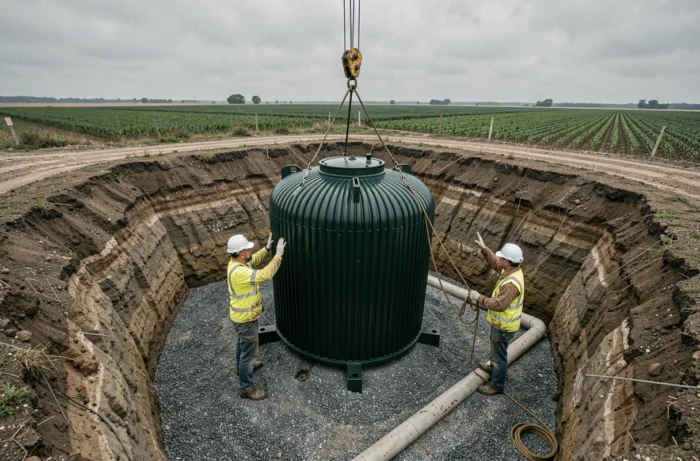
For supplementary irrigation over a few hectares, the volumes far exceed what a single polyethylene tank can offer. We then combine several tanks in a battery, or opt for a concrete tank poured on-site. The choice of material directly depends on the target volume and the accessibility of the terrain for installation machinery.
Polyethylene or Concrete: Terrain Arbitration
High-density polyethylene (HDPE) is lighter, quicker to install, and resistant to common chemicals. However, on unstable soil or in areas where agricultural machinery passes, a concrete tank withstands rolling loads better. Feedback on this point varies depending on the quality of the backfill, but it is noted that poorly weighted HDPE tanks in clayey soil pose more problems in the medium term.
- HDPE: suitable for medium volumes, quick installation with a standard mechanical shovel, sensitive to hydrostatic pressure without anchoring
- Concrete: supports heavy surface loads, favorable thermal inertia to keep water cool, but requires access for a concrete mixer or prefabricated elements
- Flexible tank: temporary or supplementary solution, not suitable for permanent burial, useful above ground for seasonal storage
Connection, Filtration, and Pump: The Complete Circuit
The tank alone is useless without a reliable collection and distribution system. In an agricultural context, the circuit includes several critical elements that determine the quality of the stored water and the longevity of the installation.
The pre-tank filter is the most neglected piece on farms. A basket filter or first flush device removes roof debris (leaves, moss, droppings) before they decompose in the tank. Without upstream filtration, the pump clogs, and the water becomes unusable for cleaning equipment.
On the distribution side, a submersible pump or a surface pump with a booster allows for direct feeding of an irrigation network or a high-pressure cleaner. The choice depends on the depth of the tank and the desired flow rate. For drip irrigation, a moderate flow is sufficient, but the pressure must remain constant.
Rainwater Regulation in Agricultural Operations Since 2024
The decree of July 12, 2024, replaced that of August 21, 2008, and modifies several points that directly affect farmers. The list of authorized uses for rainwater stored in tanks includes irrigation and equipment cleaning, but excludes drinking, meal preparation, and personal hygiene without certified treatment.
- Mandatory backflow preventer as soon as a connection to another network is planned, even in a trough connected to a supplementary drinking water supply
- Maintenance traceability: filtration and disinfection checks must be documented, a point to anticipate during a health inspection on the farm
- Formal prohibition of any direct or indirect connection between the rainwater network and the drinking water network
For farmers considering using rainwater for cleaning equipment in indirect contact with animals, maintenance traceability becomes a documented obligation, not just common sense. Non-compliance exposes one to sanctions during veterinary or environmental inspections.
The installation of an underground tank on a farm involves technical choices that must be made before the first shovel hits the ground. The soil, the actual collection volume, the material, and the regulatory framework form an inseparable whole. It is better to spend an extra week in preparation than to redo a failed excavation in the middle of the season.