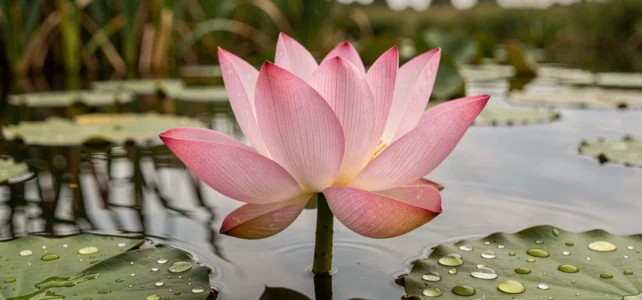
When looking for a flower to give after a trial, a bereavement, or a long convalescence, the classic reflex pushes towards white roses or lilies. The problem is that these choices often remain generic. Some flowers carry within their very biology a story of resistance to difficult conditions, and it is precisely this ability to thrive despite everything that gives them a symbolism of strength and perseverance that is much more rooted than mere floral convention.
The lotus, a flower of resilience that grows in the mud
We often talk about resilience in abstract terms. With the lotus, the metaphor becomes literal. This aquatic plant takes root in the mud, crosses murky waters, and emerges at the surface to produce an immaculate flower. This growth cycle explains why the lotus is associated with purity, renewal, and spiritual awakening in several Asian traditions.
What distinguishes the lotus from other floral symbols is that its resilience is inscribed in its biology. The plant does not avoid the mud; it traverses it. In Buddhism as in Hinduism, this trajectory from darkness to light makes it an emblem of personal transformation. This interpretation can also be found in contemporary tattoos, where the lotus remains one of the most requested motifs to mark a difficult passage or a new beginning.
Understanding the flower of resilience and hope in its symbolic dimension allows one to go beyond the simple decorative gesture and to choose a flower whose message will be understood without explanation.

Japanese plum and poppy: two forgotten symbols of perseverance
The lotus often monopolizes the conversation about flowers of resilience. We overlook other species whose symbolism is just as strong but rooted in different cultural contexts.
The plum tree in hanakotoba
In the Japanese language of flowers (hanakotoba), the plum tree – called ume – is associated with perseverance and nobility of spirit. Its blooming occurs in mid-winter, even before the cherry blossom, sometimes while snow still covers the branches. This ability to bloom in the cold makes it a symbol of silent courage.
The plum tree also evokes the return of spring. Giving a branch or representing the flower means telling someone that the difficult period will eventually give way to better days. This is a cultural angle that Western content on floral symbolism rarely addresses.
The red poppy, between memory and consolation
The poppy occupies a unique place. In the classical language of flowers, it evokes consolation and rest. But its most striking use remains commemorative: every November 11th, in Commonwealth countries, a red poppy is worn to honor the dead of World War I.
The poppy links collective memory to individual resilience. It grows spontaneously on turned soil, including battlefields, which reinforces this association between destruction and rebirth. This dual reading, both intimate and collective, gives it a depth that few flowers can claim.
Choosing a flower of resilience according to the situation
You don’t choose the same flower to accompany a bereavement, mark a healing, or celebrate a new beginning. The symbol must correspond to the concrete situation, not just to a vague intention of “giving courage.”
- For a bereavement or loss, the red poppy carries a message of consolation and memory without tipping into passive sadness. It acknowledges that pain is recognized, but life goes on.
- For a convalescence or health challenge, the lotus remains the most readable choice. Its symbolism of traversing murky waters towards the light speaks directly to the person recovering.
- For a new beginning (moving, career change, birth), the Japanese plum or the daffodil evoke renewal. Daffodils carry a symbolism of new beginnings, even though their image remains ambivalent due to the myth of Narcissus related to vanity.
- For a tattoo or a permanent object, the lotus overwhelmingly dominates, but yarrow symbolizes the healing of wounds, both physical and emotional, in reference to the hero Achilles who used it to heal his injuries.
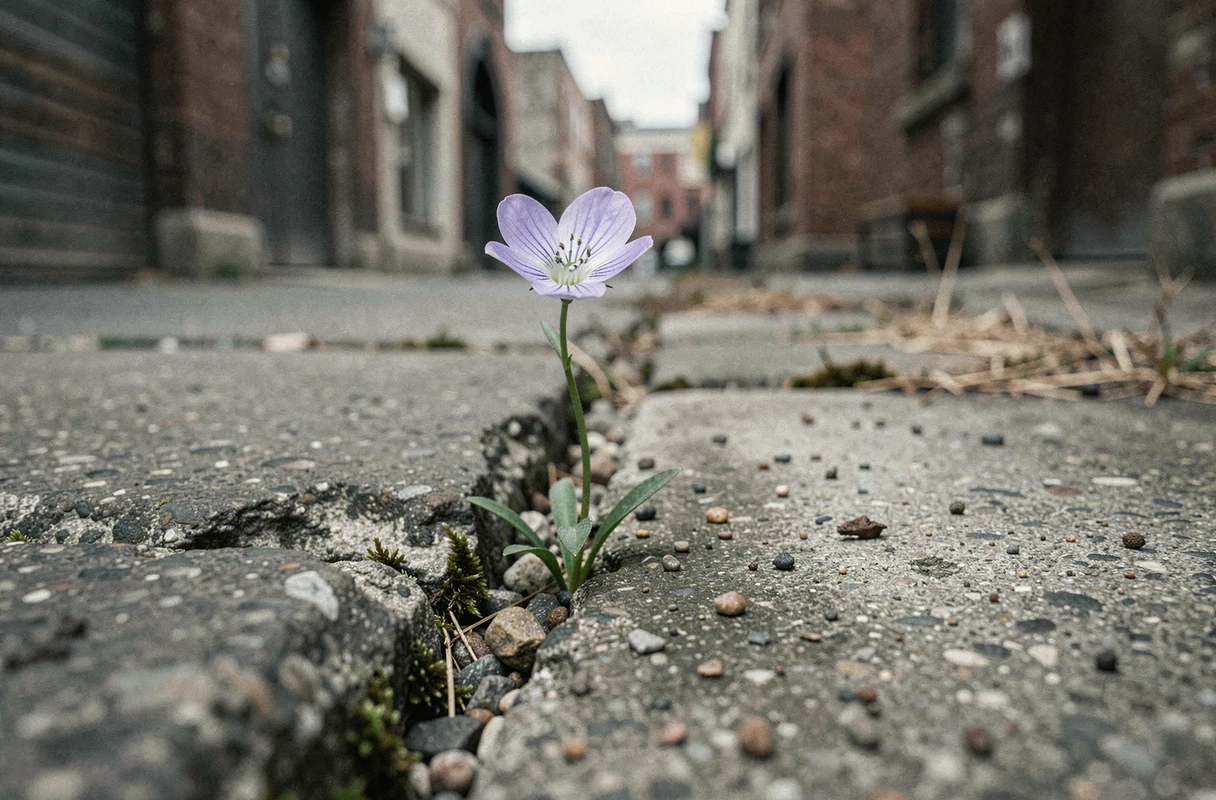
Daffodil and yarrow: the ambiguity in floral symbols
Not all flowers associated with resilience carry a univocal message. Reactions vary on this point, and it is precisely this complexity that makes the choice interesting.
The daffodil is the best example. The Royal Horticultural Society describes it as a symbol of new beginnings and renewal. At the same time, the Greek myth of Narcissus overlays a reading of pride and vanity. Giving daffodils requires knowledge of the recipient’s cultural context, lest the message be misinterpreted.
Yarrow, on the other hand, carries a more direct message. Its name refers to Achilles, the Greek hero who used this plant to heal his wounds. Wearing or giving yarrow is a reminder that suffering, no matter how intense, remains ephemeral. Its use in traditional herbal medicine reinforces this association between the plant and relief.
These nuances matter. A bouquet of resilience is not a generic bouquet with a ribbon and a card. The choice of variety, color, and cultural context transforms a simple floral gesture into a precise message. The language of flowers still works, provided one takes the time to read it correctly.