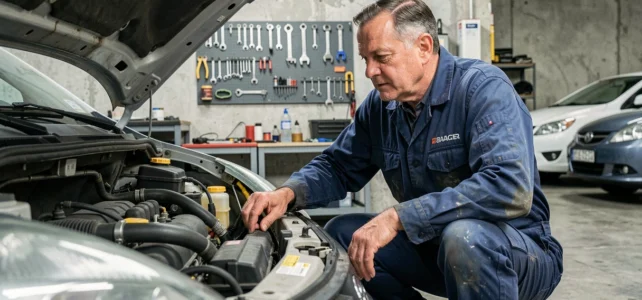
A solidarity garage is an automotive repair workshop operating under an associative status, where prices are calculated to cover operating costs without generating profit. This model, rooted in the social and solidarity economy, allows low-income motorists to maintain or repair their vehicles at a significantly lower cost than a traditional garage. There are between 150 and 200 of them in France.
A pricing model indexed to income, not just a simple discount
Most content describes solidarity garages as “cheaper.” The pricing reality is more nuanced. Several structures now practice a differentiated pricing based on the user’s income, rather than a single reduced price.
In Gaillac, Garage Solidaire 81 applies an annual membership fee that varies from 10 to 90 euros depending on the household’s resources. The hourly labor rate ranges from 30 to 45 euros, always based on the profile. This principle goes beyond the logic of a “single solidarity rate”: it adjusts the contribution to the actual financial capacity.
To access these rates, most structures require proof of family quotient or a prescription issued by a social worker. The annual membership fee, generally between 10 and 150 euros, then grants access to the workshop. In the case of a self garage (autonomous use of lifts and tools), the hourly rate often drops below 10 euros, excluding spare parts.
The network the solidarity garages references these structures across the territory and allows verification of the access conditions specific to each workshop.
Professional reintegration through automotive mechanics
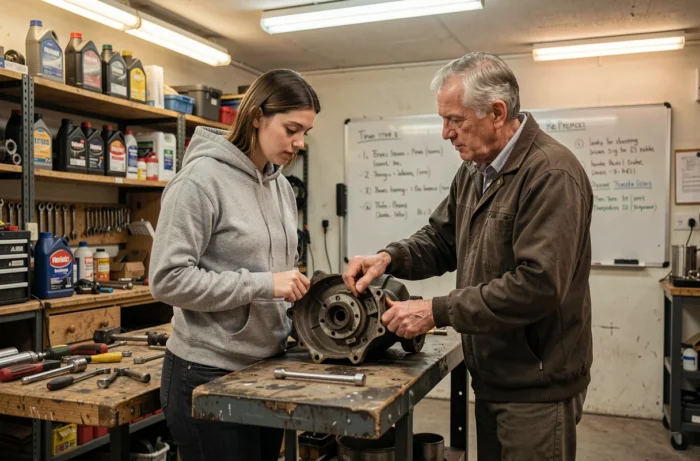
Solidarity garages do not just offer cheap repairs. Some operate as genuine economic activity reintegration devices. In Douai, a solidarity garage supports reintegration through automotive mechanics: people distanced from employment acquire technical skills under the guidance of qualified mechanics.
This dimension distinguishes the solidarity garage from a simple low-cost workshop. The user is not just a customer; they can become an actor in the repair process. Participatory workshops offer short training sessions on routine maintenance tasks (oil change, brake pad replacement, basic diagnostics).
In Compiègne, the solidarity garage is explicitly designed to prevent a car breakdown from hindering a person from continuing to work or finding a job. Mobility thus becomes a lever for reintegration, not just a comfort. This positioning justifies the public subsidies that these structures benefit from.
Financial fragility of solidarity garages: declining subsidies
The associative status implies a strong dependence on public funding. Municipal subsidies, departmental aid, regional grants, and state funds constitute the bulk of the resources that complement user contributions.
This dependence exposes solidarity garages to a concrete risk. In Gaillac, Garage Solidaire 81 lost 50% of its municipal subsidy, jeopardizing the continuity of its operations. This case illustrates a structural tension that few structures anticipate.
The consequences of a subsidy reduction directly impact the service:
- Reduction of opening hours, which lengthens response times and may push users towards unregulated repairs
- Inability to renew tools or maintain lifts to standards, directly impacting safety
- Difficulty in retaining salaried mechanics, as their presence guarantees the quality of interventions and supervision of users
A solidarity garage that closes does not just leave an empty space. It removes access to mobility for dozens of households that cannot afford to go to a traditional garage.
Services offered beyond routine mechanics
The range of services varies from one structure to another, but several solidarity garages expand their scope well beyond oil changes and tire replacements.
- Sale of revised used vehicles at moderate prices, often sourced from donations or avoided scrapping
- Rental of vehicles at social rates for job seekers or temporary workers, facilitating mobility during a mission
- Complete technical diagnostics before the technical inspection, allowing identification of refusal points and planning necessary repairs
- Collective workshops for training in routine maintenance, open to members without prior mechanical skills
The solidarity vehicle rental deserves special attention. For a person who has just secured a contract 30 kilometers from their home but does not own a car, social rate rental removes a concrete barrier to employment. This service remains little known and underdeveloped compared to demand.
Access conditions: family quotient and social prescription
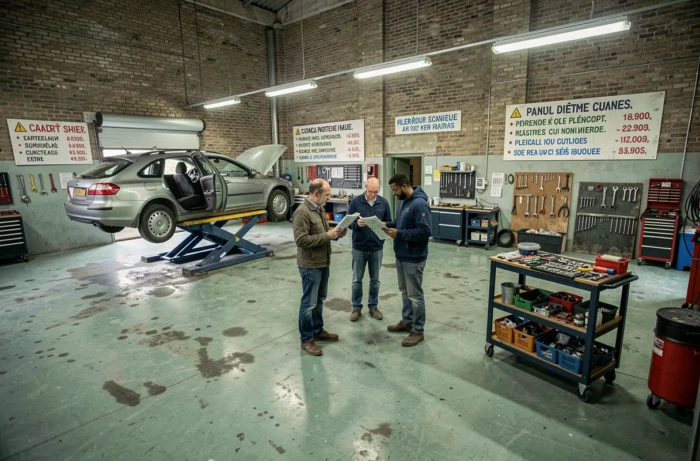
Access to solidarity garages is not free. Two main pathways allow one to benefit from them.
The first is based on the family quotient. Each structure sets a maximum threshold, which varies by territory. Below this threshold, membership is automatically possible upon presentation of a CAF certificate or a tax notice.
The second pathway is through the prescription of a social worker (social assistant, Pôle emploi advisor, RSA referent). This pathway concerns individuals whose situation cannot be reduced to a single income criterion: post-incarceration, family breakdown, sudden loss of mobility.
Some structures also open their workshops to users outside social criteria, with a higher rate but still below market prices. This mix contributes to financial balance and avoids the stigmatization of vulnerable populations.
The territorial coverage remains uneven. Rural areas, where dependence on cars is highest, are paradoxically the least well covered. A breakdown in an area without a nearby solidarity garage brings the problem back to its starting point: the inability to move to work, seek medical care, or accompany children.