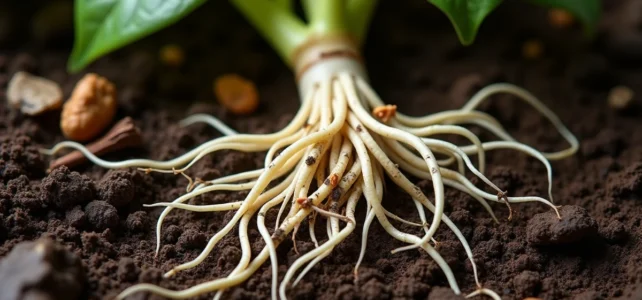
Jasmine (genus Jasminum) develops a fibrous root system, composed of numerous fine roots that branch out from the base of the stem. This root architecture concentrates the majority of water and nutrient absorption in the upper layers of the soil, where oxygen remains accessible. Understanding this functioning allows for the adaptation of cultivation practices, whether the jasmine is planted in the ground or grown in a pot on a balcony.
Fibrous root system of jasmine: what the structure implies
Unlike trees or taproot shrubs (a central axis that plunges vertically), jasmine forms a dense network of fine roots that spread horizontally. This type of system, referred to as fibrous or fasciculate, explores a wide but shallow volume of soil.
This distribution explains two behaviors often observed in the garden. First, jasmine quickly colonizes the available surface around its base, allowing it to effectively capture moisture after rain or light watering. Secondly, its roots are sensitive to compaction and standing water, as they depend on the presence of oxygen in the first few centimeters of soil.
To better understand the depth of jasmine roots, it is necessary to distinguish between two cultivation situations that radically modify root behavior: in the ground and in a container.
Depth of jasmine roots in the ground
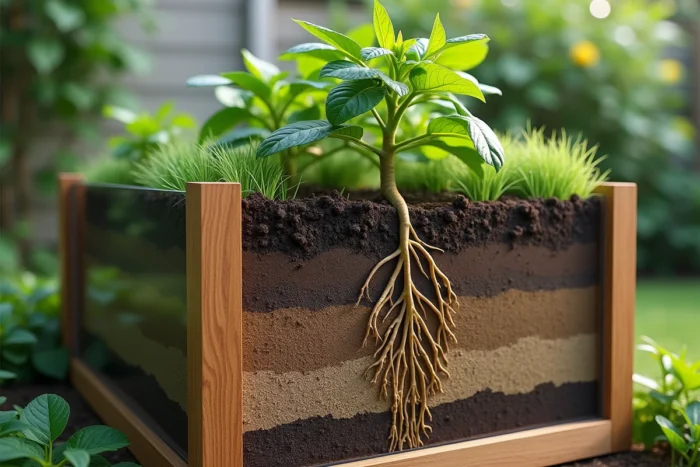
In the ground, the majority of a Jasminum’s roots remain concentrated in the first few centimeters of soil. This area corresponds to the layer richest in organic matter and best oxygenated. An adult jasmine planted for several years in loose soil can, however, send some roots deeper, provided that the substrate is neither compacted nor waterlogged.
The determining factor is not the species alone, but the frequency and depth of watering. Shallow and daily watering keeps the roots in the upper layer, as they have no reason to seek water deeper. Conversely, deep and spaced watering encourages the roots to descend to follow the moisture front that migrates through the soil profile.
This principle, well documented for plants with fibrous systems, applies particularly to jasmine. Gardeners who space out their watering by allowing the surface to dry between two applications observe a more robust rooting and better resistance to summer drought episodes.
Soil nature and rooting
Sandy, porous, and well-drained soil facilitates the penetration of roots into the lower layers. Clayey, dense, and poorly aerated soil limits progression and promotes superficial spreading.
Jasmine prefers neutral to slightly calcareous, rich, and cool soil. Adding mature compost to the surface every spring improves the structure of the top few centimeters and encourages healthy rooting, without the need to work the soil deeply.
Jasmine roots in pots: constraints and adaptation
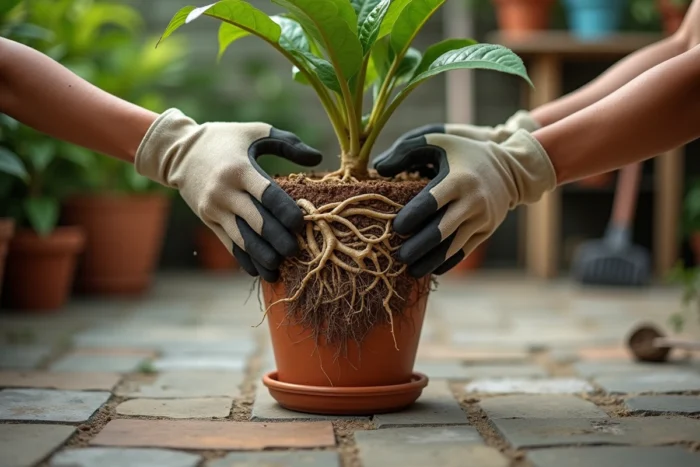
In pots, the root system of jasmine is physically limited by the walls of the container. The fibrous roots quickly occupy the entire available volume and end up circling themselves against the walls, a phenomenon called root balling. This spiraling gradually reduces the plant’s absorption capacity.
Current recommendations for pot cultivation advocate for a container that is deep enough, with real drainage holes at the bottom. The depth of the pot is as important as its diameter, as it provides the roots with vertical space that compensates for the lack of natural soil beneath.
- Choose a pot whose depth is at least equal to its diameter, to allow for minimal vertical root development
- Place a drainage layer (clay balls, shards, gravel) at the bottom to prevent roots from sitting in standing water
- Use a draining mix combining potting soil, mature compost, and perlite or coarse sand, to maintain substrate aeration
- Repot when roots emerge from the drainage holes or growth slows, without oversizing the new container
Repotting should not be neglected. A potted jasmine with compressed roots blooms less and shows yellowing foliage at the base, a classic sign of root asphyxiation.
Air pruning technique
Some containers made of geotextile fabric or with perforated walls allow for what is called “air pruning” of the roots. When a root reaches the air-permeable wall, it dries out at the tip and stops elongating. The plant responds by producing new lateral branches within the substrate, resulting in a denser and better-distributed root system.
This technique, used in nurseries, is well-suited for jasmine grown in pots on a balcony or terrace. It prevents root balling and improves the overall absorption capacity of the fibrous system.
Watering and root development of jasmine: the key variable
The effective depth of the roots depends more on water management than on the plant’s genetics. This is a point that classic cultivation guides rarely mention accurately.
In the ground, the most effective method is to water abundantly but spaced out. Allowing the soil to dry on the surface between waterings forces the roots to progress towards deeper water reserves. This moderate water stress, far from weakening jasmine, strengthens the anchorage and resilience of the plant against heat waves.
In pots, the substrate dries out faster than in the ground. Watering should remain regular to avoid complete drying of the root ball, but the principle remains the same: do not keep the substrate constantly moist. Systematically emptying the saucer after each watering protects the fibrous roots from rot.
- In the ground: water deeply once or twice a week in summer, allowing the surface to dry between applications
- In pots: check the substrate moisture with your finger before each watering, never leave water in the saucer
- In winter: significantly reduce watering, jasmine enters a vegetative rest and its roots absorb very little
Star jasmine (Trachelospermum jasminoides), often confused with true jasmine, follows similar principles. Its fibrous root system reacts in the same way to watering management, although it belongs to a different botanical family (Apocynaceae rather than Oleaceae).
Adapting watering to the type of cultivation remains the most direct lever to influence the depth and quality of jasmine rooting, whether it is a wall-trained Jasminum officinale or an Arabian jasmine in a pot on an urban terrace.