
The appearance of the tonsils, bright red or covered with a whitish coating, remains the first observation reflex in consultation. However, this visual criterion alone does not allow for distinguishing between a viral and a bacterial origin. We regularly observe erythematous angina (red) of streptococcal origin, and erythematous-purulent angina (white) that is purely viral. The relevant distinction relies on a bundle of clinical signs, not on color.
Absence of cough and rhinitis: the underestimated discriminating criterion
The majority of popular articles contrast white angina and red angina as if this dichotomy guides the etiological diagnosis. In clinical practice, the absence of cough is a much more reliable marker than a purulent deposit for suspecting a group A streptococcal angina.
A presentation combining sudden onset, high fever, tonsillar exudate, painful cervical lymphadenopathy, and especially the absence of cough or rhinitis points towards a streptococcal origin. Conversely, pharyngeal irritation accompanied by cough, nasal discharge, or hoarseness strongly suggests a virus (rhinovirus, adenovirus, influenza, SARS-CoV-2).
We therefore recommend never to base the evaluation solely on the visual inspection of the tonsils. Knowing how to recognize white or red angina starts with analyzing the associated signs, well before considering the color of the throat.
Clinical score and rapid diagnostic test: what really makes the difference
The Mac Isaac score remains the reference triage tool in outpatient medicine. It assigns points based on the presence or absence of specific criteria:
- Fever above the expected threshold, tonsillar exudate, painful anterior cervical lymphadenopathy, absence of cough: each present element increases the streptococcal probability.
- A low score (few positive criteria) renders the rapid diagnostic test (RDT) unnecessary and antibiotic therapy unjustified.
- A high score justifies performing the RDT, the result of which conditions the prescription of amoxicillin.
The RDT detects streptococcal antigen in a few minutes from a pharyngeal sample. Its high specificity means that a positive result reliably confirms the presence of the bacteria. A negative result, combined with a low clinical score, reasonably excludes streptococcus and directs towards symptomatic management.
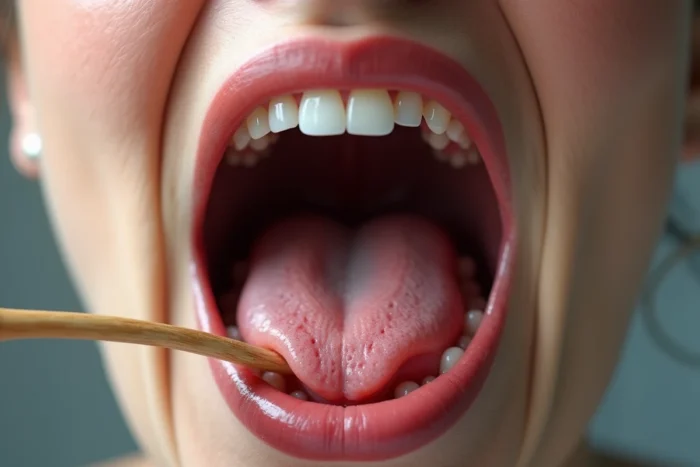
The color of the tonsil (white or red) does not factor into this score. This is a point that popular articles almost systematically overlook, perpetuating the false idea that a white coating implies a bacterial infection.
Ibuprofen and self-medication: an underestimated risk of complications
Many patients spontaneously take a non-steroidal anti-inflammatory drug in response to severe throat pain. The Antibiomalin platform, led by French health authorities, warns that self-medication with ibuprofen can worsen the complications of angina. The risk particularly concerns peritonsillar phlegmon, a purulent collection that requires surgical drainage.
Paracetamol remains the first-line analgesic. It alleviates pain and fever without promoting the spread of infection. In cases of poorly controlled pain, consultation allows for adapting the analgesic strategy rather than escalating to an over-the-counter NSAID.
This precaution applies equally to red angina and white angina. The type of angina does not change the relative contraindication of ibuprofen in self-medication.
Angina in children: clinical particularities and diagnostic pitfalls
In infants and young children, angina often presents atypically. Throat pain is not always verbalized. A sudden refusal to eat, excessive salivation, or febrile irritability should raise suspicion of the diagnosis.
Before three years of age, group A streptococcal angina is rare. Most anginas in this age group are viral, regardless of the color of the tonsils. The RDT is not routinely recommended before this age. However, we still observe prescriptions for antibiotics motivated by a simple white coating, illustrating the persistent confusion between visual appearance and etiology.
- In children over three years old with an evocative presentation (fever, pain, lymphadenopathy, absence of cough), the RDT is indicated.
- A negative RDT result is sufficient to avoid prescribing antibiotics, even if the tonsil appears very inflamed.
- Contagiousness necessitates limited school exclusion after the initiation of any potential antibiotic treatment, but a viral angina does not justify antibiotic therapy, whether white or red.

Duration of symptoms and warning signals
A viral angina resolves spontaneously within a few days. With appropriate antibiotic treatment, a streptococcal angina improves significantly within the first 48 hours. Persistent fever beyond this timeframe, worsening dysphagia, or trismus (difficulty opening the mouth) should prompt urgent reevaluation.
Trismus associated with angina indicates a possible peritonsillar phlegmon, a complication that requires hospital management. This warning signal is valid regardless of the initial appearance of the tonsils.
The distinction between white angina and red angina retains descriptive utility in semiology. It allows for describing the observed appearance during clinical examination. However, it does not replace the clinical score, the RDT, or the evaluation of associated signs to guide management. It is better to remember the functional criteria (cough, rhinitis, mode of onset, fever) than just the color of the throat.