
Sankore refers both to an intellectual heritage linked to the university of Timbuktu and a digital educational ecosystem developed to facilitate access to educational resources. The name refers to the Sankore mosque, a center of knowledge founded six centuries ago, whose mission of transmission continues today through software tools and online platforms designed for teachers and students.
Sankore and the Open-Sankore Software: Technical Foundation for Digital Teaching
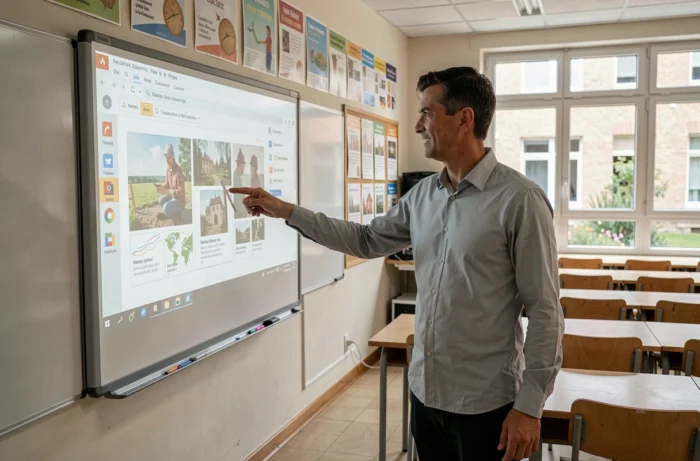
The Open-Sankore software is a free program designed for interactive whiteboards (IWBs) and interactive projectors. Its principle is based on an interface where the teacher creates, annotates, and organizes teaching sequences directly projected in the classroom.
This software works on major operating systems. It allows the integration of animations, text documents, image files, and multimedia content in a single workspace. The teacher can thus adapt each sequence to the level of their students, from primary to middle school.
The uniqueness of Open-Sankore lies in its free license: any teacher can download it, modify it, and redistribute their own resources. This openness has generated a community of contributors who share ready-to-use lessons, particularly in mathematics, science, and languages. To explore the content of Sankore, the online platform gathers these resources classified by subject and school level.
Digital Educational Resources: What Sankore Offers Specifically
The Sankore platform is not limited to interactive whiteboard software. It provides access to a catalog of digital educational resources organized to meet the curricula of several countries, particularly in Francophone Africa.
Types of Available Content
- Ready-to-use interactive lesson sequences covering mathematics, science, French, and history-geography, from primary to middle school
- Animations and exercises that can be integrated into Open-Sankore or other compatible digital media, allowing for varied pedagogical approaches
- Supporting documents for teachers, including user guides and proposals for class scenarios adapted to different contexts (urban school, rural school, distance learning)
This organization by level and discipline facilitates the search for a teacher preparing a lesson. Each resource is aligned with a specific educational objective, which avoids tedious sorting through general content banks.
Cultural Heritage of Sankore and Digital Continuity
The university of Sankore, in Timbuktu, functioned for centuries as a center for the transmission of knowledge, housing thousands of manuscripts covering astronomy, medicine, law, and theology. In July 2026, UNESCO supported the communities of Timbuktu to celebrate the 600th anniversary of the Sankore mosque, reminding us of this historical role as an intellectual crossroads.
This recent commemoration sheds light on the choice of name for digital tools. The transition from the manuscript library to the online platform reflects the same logic: making knowledge accessible beyond geographical borders. The manuscripts of Timbuktu circulated among scholars in West Africa; Sankore’s digital resources circulate among connected teachers.
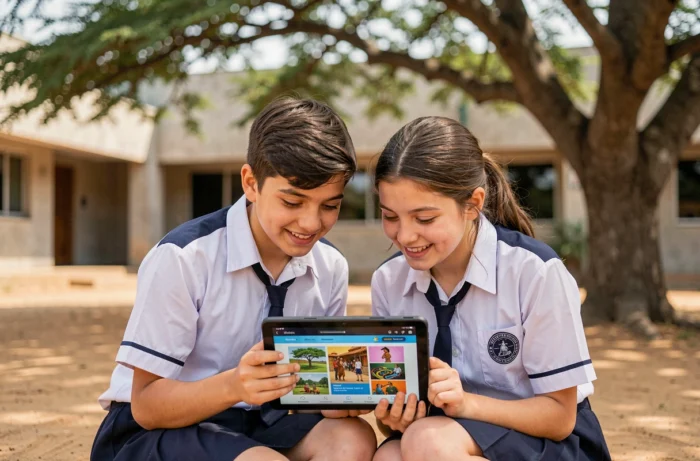
This link between heritage and digital gives Sankore a distinct identity in the online education landscape. It is not just a technical tool, but a project that places pedagogical innovation within a tradition of knowledge sharing.
Digital Education in Africa: The Framework in Which Sankore Fits
The African Union adopted a digital education strategy in 2022 that structures continental initiatives around four axes:
- Access to digital infrastructure in schools, including rural areas
- The creation and dissemination of digital educational resources adapted to local curricula
- The development of a private EdTech sector capable of supporting the educational ecosystem
- Training teachers in the digital skills necessary to use these tools in the classroom
Sankore fits directly into the first two axes. The Open-Sankore software addresses the need for accessible tools (free, lightweight, compatible with modest hardware). The resource platform meets the need for content aligned with local school curricula, a point that major international educational platforms do not always cover.
Teacher Training and Classroom Adoption
One of the barriers to the adoption of digital tools in schools remains training. The Canopé network in France has produced self-training modules dedicated to Open-Sankore, covering everything from getting started to advanced features. These modules include screenshots and videos that allow a teacher to progress independently.
The peer training approach complements this system. Teachers who master the software share their sequences and feedback, which reduces the learning curve for new users. This collaborative dynamic is what distinguishes the Sankore ecosystem from a simple download catalog.
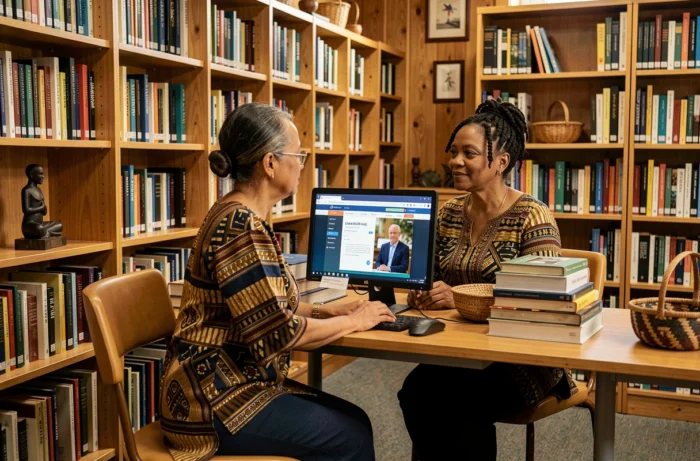
The choice of free software also facilitates adaptation: an academy or ministry can modify the interface, add local languages, or integrate specific content without relying on a commercial publisher. This technical flexibility meets the diversity of school contexts, from Francophone middle schools to bilingual programs.
Sankore remains an evolving project. The recent celebration of the 600th anniversary of the mosque reminds us that the transmission of knowledge has always relied on human networks as much as on materials. Tools change, the logic of sharing remains the same.