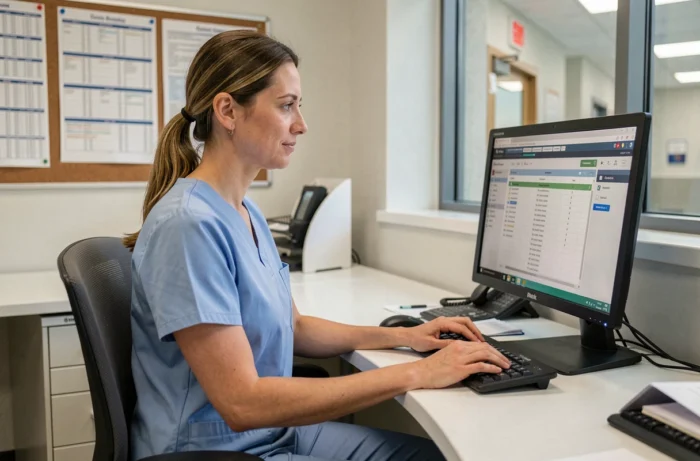
A night agent finishing their shift at 6 AM and wanting to check their RTT balance before leaving the site often encounters a position already occupied by the health manager. From a personal smartphone, connecting to the extranet portal of the CHU of Clermont-Ferrand sometimes fails without explanation. This kind of daily friction affects the majority of non-medical staff who use Chronos Santé to view their schedules and working time data.
Extranet portal of CHU Clermont-Ferrand: what blocks the connection
Access to Chronos goes through the CHU’s authentication portal, hosted on the domain extranet.chu-clermontferrand.fr. One enters their username (usually the staff ID) and password. On the hospital’s internal network, the connection is direct.
The problem arises when trying to connect from outside. French hospitals are gradually deploying multi-factor authentication for remote access. Specifically, a second factor (code sent via SMS, application like Microsoft Authenticator, or OTP code) may be required for any connection outside the internal network.
At the CHU of Clermont-Ferrand, feedback varies on this point: some agents report direct access from home, while others face an additional validation request. This disparity is explained by the gradual deployment of MFA according to services and access profiles configured by the IT department.
To access Chronos CHU Clermont-Ferrand without blockage, it’s advisable to prepare your access before the first attempt off-site, rather than discovering the procedure on a Sunday evening.
Preparing your Chronos Santé access before the first remote connection
Most connection failures stem from a poorly configured account beforehand. Before leaving the hospital, three checks can help avoid remote blockage.
- Ensure that your mobile phone number is correctly entered in the HR directory of the CHU, as this number receives the validation code if MFA is activated for your profile.
- Test a first connection to the extranet portal from an internal workstation to ensure the password works, then change the temporary password if the IT department assigned one when opening the account.
- Install the authentication application recommended by the CHU (Microsoft Authenticator in most cases) on your personal phone and link it to your staff account before leaving the internal network.
- Note the exact address of the portal in your favorites: a typo in the URL redirects to a generic error page that does not specify the correct address.
These steps may seem obvious, but it is noted that the majority of tickets opened with the CHU’s IT support concern password issues or unconfigured second factors.
Navigating Chronos Santé: schedule, balance, and absence requests
Once connected, the Chronos Santé interface consolidates the working time data of the agent. The software, published by Asys, meets the needs of both non-medical and medical staff at the CHU of Clermont-Ferrand. The establishment has 1,932 beds spread across 3 sites, and Chronos manages the schedules for the entire area, including the facilities of the GHT Allier-Puy-de-Dôme.
Consulting your schedule and counters
The main screen displays the monthly schedule with the hours validated by the health manager. The counters (overtime, RTT, annual leave) appear in summary. The data is updated after validation by the manager, not in real-time: a delay of a few days is normal after a schedule change.
To check a balance before making a request, consult the counters tab rather than counting manually on the schedule. The two do not always visually match, as the schedule shows the programmed days while the counters include HR adjustments.
Making an absence request from Chronos
The request is made directly in the application. You select the type of absence, the dates, and confirm. The health manager receives the request and either accepts or denies it in the tool. No paper form is necessary for absences managed in Chronos, which avoids back-and-forth trips to the scheduling office.
A point to watch: if the request remains pending for more than a few days, follow up with the manager directly rather than sending a second request in Chronos. Duplicates complicate processing on the HR manager’s side.

Lost password or blocked account: recourse at CHU Clermont-Ferrand
The most common case remains the forgotten password. The CHU’s authentication portal sometimes offers a reset procedure by email, provided that the professional email address is associated with the account.
If this option does not work (email not provided, account locked after several attempts), you must contact the CHU’s IT support. The quickest way is to go through the contact form or the IT service phone during business hours. On weekends or at night, troubleshooting is rarely immediate.
For agents working irregular hours, a workaround is to ask their health manager to check the schedule or the balance of counters from their own Chronos access. This is not ideal in terms of autonomy, but it helps while waiting for the reset.
Network security and best practices for hospital staff
The tightening of access to hospital tools responds to a reality: healthcare establishments are regular targets of cyberattacks in France. National cybersecurity recommendations require hospitals to strengthen the protection of their agents’ and patients’ data.
From the agent’s side, a few reflexes can limit risks:
- Never save your Chronos password in a shared browser or on a publicly accessible workstation in a department.
- Use a password distinct from that of your personal email.
- Always log out of the portal after consultation, including on smartphones.
A compromised account can grant access to the personal and social data of the agent (schedules, address, administrative situation). Vigilance on this point protects both the agent and the establishment.
The CHU of Clermont-Ferrand, like other establishments of the GHT, regularly evolves its access procedures. When the IT department sends an email announcing a change in connection procedure, reading it before attempting your next connection avoids most blockages.