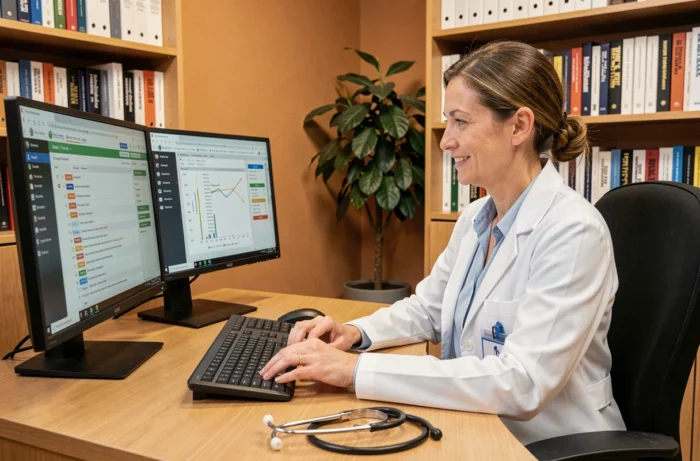
With the Digital Grant (DONUM) coming into effect at the beginning of 2026, the new article R.4127-13-1 of the code of ethics regarding the use of AI and the increasing telemedicine tools, the regulatory and technical framework of medical practice is evolving rapidly. What concrete levers are available today to reduce administrative burdens, secure health data exchanges, and improve patient follow-up in private practice?
Digital Grant DONUM and ethical framework: what changes for medical practices in 2026
As of January 1, 2026, the Digital Grant (DONUM) replaces the Structural Package for liberal doctors. The mechanism remains a support for equipment and digital usage, but the amount can reach €2,940 per year for practitioners using a Ségur-referenced software, a secure health messaging system, the Health Insurance tele-services, or the feeding of My Health Space.
This funding now also covers certain AI-assisted writing modules and online appointment booking, provided that the tools comply with state referencing. For doctors who were hesitant to invest in teleconsultation software or outsourced telephone secretarial services, DONUM changes the financial equation.
At the same time, decree n° 2026-691 of July 27, 2026, creates article R.4127-13-1 in the medical ethics code. This text specifically regulates the use of digital technologies and artificial intelligence systems in healthcare practice. Any doctor integrating an AI tool must be able to explain its functioning to the patient and assume clinical responsibility.
Professionals wishing to delve deeper into these digital solutions and their practical implications can consult the Dr Hackney net website to identify resources suitable for their specialty.
| Criterion | Old Structural Package | DONUM (2026) |
|---|---|---|
| Maximum annual amount | Variable based on indicators | Up to €2,940 |
| Medical AI coverage | Not provided | Eligible Ségur-referenced modules |
| Ethical obligation for AI | No specific provisions | Article R.4127-13-1 of the ethics code |
| Secure messaging | Encouraged | Eligibility condition |
Teleconsultation and tele-expertise: two telemedicine tools with distinct logics
Teleconsultation directly connects the doctor and their patient via video. Tele-expertise, on the other hand, connects two healthcare professionals: a requesting physician and a required specialist. The two systems address different needs, and their impact on the organization of the practice is not the same.
Teleconsultation reduces travel time for the patient and allows the doctor to maintain a steady flow of consultations, especially in under-served areas. In contrast, tele-expertise shortens the time to obtain a specialized opinion without mobilizing an additional patient slot. A general practitioner can send a file (imaging, biology, photos) to a dermatologist or cardiologist and receive structured feedback within a short timeframe.
Points of caution for integration into the practice
Tele-expertise prevents the patient from undergoing an unnecessary specialized consultation, freeing up medical time on both sides. For these tools to work on a daily basis, three conditions must be met:
- A Ségur-referenced professional software capable of sending and receiving documents via the secure health messaging system (MSSanté)
- A stable internet connection with sufficient bandwidth for video, which remains a real barrier in some rural areas
- Complete traceability in the patient file: each telemedicine act must be documented as a physical consultation
Health data and My Health Space: structuring the exchange with the patient
My Health Space has been activated for nearly all social security beneficiaries since 2022. Each healthcare professional can deposit documents (prescriptions, reports, liaison letters) and exchange secure messages with their patients, depending on their specialty and the permissions granted.
Regular feeding of My Health Space is a criterion for eligibility for DONUM. It is no longer an optional use: public funding is conditioned on the effective use of this space. For the doctor, this means integrating document deposits into the daily workflow, ideally in an automated manner from the professional software.
Prevention and long-term follow-up
The patient space also allows for the relay of targeted prevention content. A doctor can send a vaccination reminder, a post-operative protocol, or a follow-up questionnaire directly into the patient’s space. This secure channel replaces unencrypted email exchanges, which pose a compliance problem regarding GDPR and the e-health framework.
CPTS and coordinated practice: pooling tools among healthcare professionals
The Territorial Professional Health Communities (CPTS) bring together doctors, nurses, pharmacists, and other professionals from the same area. Their interest in optimizing medical practice lies in pooling: shared secretarial services, common care protocols, coordination platforms.
A CPTS, for example, allows for organizing access to unscheduled care without overloading a single practice. The doctor participating in this territorial network reduces the pressure on their own active patient list while improving continuity of care for their patients.
Membership in a CPTS also opens access to collective funding for shared digital tools: shared online calendar, tele-expertise protocols among members, coordinated prevention actions. These investments would be difficult to make profitable for an isolated practice.
The choice of a digital tool, whether it be teleconsultation software, an AI module, or secure messaging, depends less on its raw functionalities than on its integration into the practice’s ecosystem and the territory. DONUM and the new ethical article establish a clear framework: funding exists, as do obligations. The determining criterion remains the Ségur compatibility of the professional software, which conditions both financial aid and regulatory compliance.